

04 Sep Advocacy Matters: Three Ways We Can Help the T1D Community Right Now
When our family first entered the world of type one diabetes (T1D), we were focused on insulin ratios, blood sugar trends, pumps, continuous glucose monitors and the endless decisions that come with keeping someone with T1D safe.
Over time, we learned that some of the biggest challenges facing people with T1D cannot be solved in a doctor’s office. The cost of insulin, access to treatments and the pace of research are also shaped by public policy.
Advocacy is simply telling decision-makers what life with T1D really looks like—and asking them to help make it safer, more affordable and more hopeful.
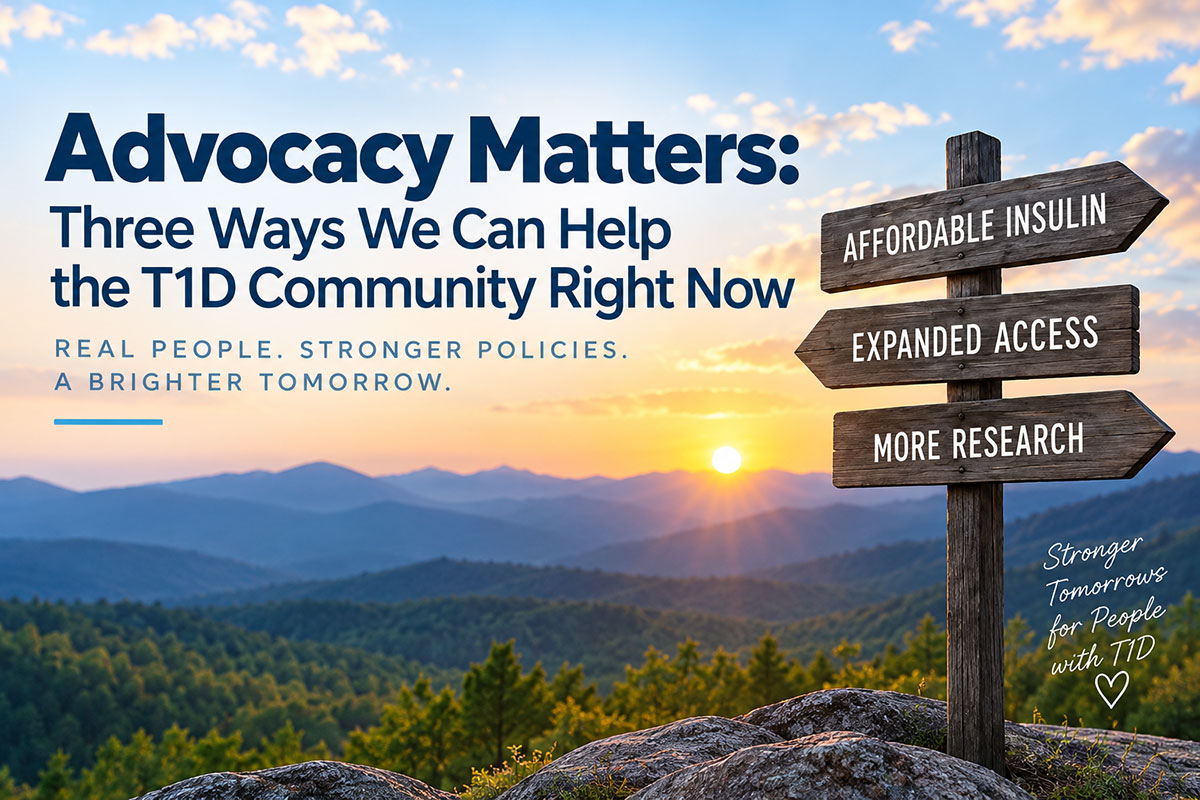
Right now, there are three places where our voices can make a difference.
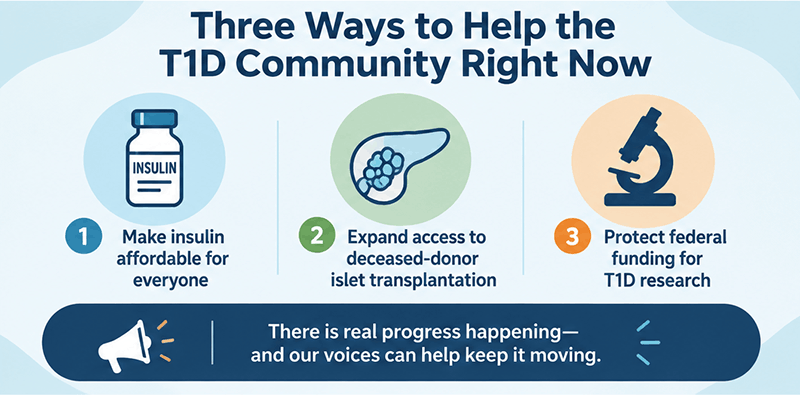
1. Make insulin affordable for everyone
Insulin is not optional. For families like ours, that isn’t an abstract policy statement. Insulin is part of every single day, and reliable access to it is nonnegotiable.
There is encouraging bipartisan movement in both chambers of Congress on the INSULIN Act of 2026, legislation designed to make insulin more affordable for people with private and employer-sponsored insurance and improve access for people who are uninsured.
In the Senate, the bipartisan INSULIN Act of 2026 (S. 4189) would limit out-of-pocket insulin costs for people with private and employer-sponsored insurance, promote generic and biosimilar competition, restrict certain barriers to accessing covered insulin and establish a pilot program to help uninsured people obtain insulin for $35 per month.
The Senate bill has made meaningful progress. On July 22, the Senate Health, Education, Labor and Pensions (HELP) Committee advanced the bill by a bipartisan 17–5 vote. On August 7, the amended bill was formally reported to the Senate and placed on the Senate Legislative Calendar. It has not yet received a vote by the full Senate.
Now, there is important news from the House. On September 2, Representatives Diana DeGette (D-CO), Mariannette Miller-Meeks (R-IA), Kim Schrier (D-WA), Rob Bresnahan Jr. (R-PA) and Angie Craig (D-MN) introduced the bipartisan House INSULIN Act, H.R. 10227. Like its Senate counterpart, the House legislation would cap out-of-pocket insulin costs at $35 per month for people with private insurance and includes additional measures intended to improve insulin affordability and access.
H.R. 10227 has been referred to the House Committees on Energy and Commerce, Ways and Means, and Education and Workforce.
This is real progress—but neither bill has passed its chamber yet. And because the 119th Congress ends this year, legislation that does not become law will have to begin the legislative process again in the next Congress.
What we can do: Our advocacy now matters in both the House and Senate. Contact your U.S. representative and ask them to cosponsor and support H.R. 10227. Contact your U.S. senators and ask them to support S. 4189 and help bring it to a vote.
A message can be simple:
I am a constituent and part of a family affected by type one diabetes. Please support the bipartisan INSULIN Act of 2026 and efforts to make insulin reliably affordable for everyone who needs it. No one should have to ration a life-sustaining medication because of cost.
Then add a sentence or two about what insulin access means to your own family. That personal piece matters.
2. Expand access to deceased-donor islet transplantation
This is an area we’re watching with particular interest (and hope!).
Pancreatic islets are clusters of cells that include the beta cells that produce insulin. In an islet transplant, islets isolated from the pancreas of a deceased organ donor are infused into a person with T1D, where functioning cells may once again produce insulin.
The treatment is currently aimed at a relatively small group of adults with severe hypoglycemia despite intensive diabetes management, and recipients require medication to prevent rejection.
In 2023, the Food and Drug Administration (FDA) approved Lantidra, the first deceased-donor pancreatic-islet cellular therapy approved for certain adults with T1D and recurring severe hypoglycemia. Under the current U.S. framework, donor-islet preparations are regulated as biological products, which means centers generally face the FDA biologics-licensing pathway.
Breakthrough T1D is asking the Department of Health and Human Services (HHS) to change that framework for unmodified deceased-donor islets, classifying them as organs for transplantation rather than solely as biologic drugs. The organization argues that experienced transplant centers could then operate within an organ-transplant system with appropriate accreditation and safety and quality standards rather than each needing to navigate the same drug-approval structure.
There has also been congressional interest through the ISLET Act, but current advocacy is focused heavily on HHS because supporters contend the department already has authority to make the change administratively. Senator Mike Lee renewed that request to HHS in July, and Breakthrough T1D met with senior FDA and Health Resources and Services Administration (HRSA) officials in August to discuss the proposal.
As a T1D family, we’ve learned to be cautious about the word “cure,” but we also pay attention when research begins removing one barrier after another.
This is where some exciting research from the University of Chicago and Eledon Pharmaceuticals fits in.
Researchers at UChicago Medicine are studying tegoprubart, Eledon’s investigational anti-CD40L antibody, as part of a calcineurin-inhibitor-free immunosuppression regimen following deceased-donor islet transplantation.
In results presented at the American Diabetes Association Scientific Sessions in June, all 12 participants had achieved insulin independence, all had most-recent A1Cs below 6.5%, and no severe hypoglycemic episodes had been reported after transplantation. Follow-up was still relatively short—median eight months, with the longest at 22 months—so these results are encouraging but preliminary.
Importantly, tegoprubart does not eliminate the need for immune suppression, nor does it change the regulatory classification of donor islets. It is addressing a different barrier—whether transplant rejection can be prevented without relying on some of the traditional immunosuppressive drugs that can themselves damage kidney function and transplanted islets. UChicago’s study remains an investigational clinical trial.
And there is a brand-new development: on September 3, 2026, Eledon announced that it submitted an Investigational New Drug application to the FDA for a planned company-sponsored, registrational study of tegoprubart in islet transplantation.
Put together, these two efforts are complementary—better access to donor islets and better ways to protect those transplanted cells.
Neither makes donor-islet transplantation a universal cure. Donor tissue remains limited, recipients must be carefully selected, and immune suppression still carries risks. But, for people living with severe, dangerous hypoglycemia, this could become a much more meaningful treatment option.
What we can do: Ask HHS to create an appropriate organ-transplant pathway for unmodified deceased-donor islets while maintaining rigorous safety and quality standards.
3. Protect federal funding for T1D research
Finally, we need to protect the research pipeline that makes advances like these possible.
The Special Diabetes Program (SDP) provides dedicated federal funding for T1D research through the National Institutes of Health. Congress extended the program through December 31, 2026, and increased annual funding from $160 million to $200 million. Congress also increased diabetes research funding at the National Institute of Diabetes and Digestive and Kidney Diseases.
That is worth celebrating. But, unless Congress acts again, the SDP expires at the end of this year.
The program has helped support work that contributed to automated insulin-delivery systems, disease-modifying therapies and beta-cell replacement research. Stable funding matters because science does not move neatly from one short-term federal extension to another.
What we can do: Thank Congress for strengthening the SDP—and ask lawmakers to renew it before December 31.
Please support a long-term renewal of the Special Diabetes Program. Stable, sustained federal funding is essential to advancing T1D prevention, treatment and cure research.
Our stories have power
Advocacy does not require expertise in legislation or medicine. It can begin with an email, a phone call or a few sentences explaining what T1D asks of a person and family every single day.
Our family has spent years calculating insulin doses, watching glucose arrows, navigating insurance and following research with equal parts hope and patience. Thousands of other families know that rhythm, too.
Policy can feel far removed from those everyday moments, but it isn’t. I spent my early career in Washington, and one of my biggest takeaways is that our stories help decision-makers understand what is at stake. When we share them—kindly, clearly and persistently—we help move the T1D community forward.
—Megan
Policy, regulatory and research information in this post was verified September 3, 2026. Because legislation and regulatory actions can change quickly, please confirm current status before contacting public officials.
Sources & Further Reading
We want The Helpful Type to be a place where families can learn more and verify information for themselves. Whenever possible, the links below lead to government records, regulatory documents, academic medical centers and other primary-source material.
Insulin Affordability and the INSULIN Act of 2026
U.S. Government Publishing Office — H.R. 10227, INSULIN Act of 2026
Official text and legislative information for the House INSULIN Act, introduced September 2, 2026.
https://www.govinfo.gov/app/details/BILLS-119hr10227ih
U.S. Government Publishing Office — S. 4189, INSULIN Act of 2026
Official text of the Senate INSULIN Act as reported to the Senate on August 7, 2026.
https://www.govinfo.gov/app/details/BILLS-119s4189rs
Office of Representative Diana DeGette — Bipartisan House INSULIN Act
Information from one of the bill’s lead sponsors about the bipartisan House legislation and its $35 monthly insulin out-of-pocket cap.
https://degette.house.gov/media-center/press-releases/degette-delivers-bill-cap-insulin-cost-35-month
Deceased-Donor Islet Transplantation
U.S. Food and Drug Administration — FDA Approval of Lantidra
FDA announcement of its 2023 approval of Lantidra (donislecel) for certain adults with T1D and recurrent severe hypoglycemia.
https://www.fda.gov/news-events/press-announcements/fda-approves-first-cellular-therapy-treat-patients-type-1-diabetes
FDA — Lantidra Product and Regulatory Information
FDA regulatory information, including prescribing and approval documents.
https://www.fda.gov/vaccines-blood-biologics/lantidra
FDA — Considerations for Allogeneic Pancreatic Islet Cell Products
FDA guidance describing the regulatory framework for allogeneic pancreatic-islet cellular products.
https://www.fda.gov/regulatory-information/search-fda-guidance-documents/considerations-allogeneic-pancreatic-islet-cell-products
Breakthrough T1D — Proposal to Reclassify Deceased-Donor Islet Cells as Organs for Transplantation
Breakthrough T1D’s March 2026 proposal asking HHS to create an organ-transplant pathway for unmodified deceased-donor pancreatic islets.
https://www.breakthrought1d.org/wp-content/uploads/2026/03/Deceased-Donor-Islet-Cell-Proposal.pdf
Breakthrough T1D — August 2026 FDA and HRSA Meetings
Update on meetings with federal officials regarding the deceased-donor islet proposal.
https://www.breakthrought1d.org/for-the-media/statements/breakthrough-t1d-meets-with-fda-and-hrsa-leaders-to-accelerate-access-to-t1d-therapies/
University of Chicago / Eledon Islet-Transplant Research
UChicago Medicine — Clinical Trial NCT06305286
Details of the ongoing UChicago trial studying deceased-donor islet transplantation with tegoprubart as part of a calcineurin-inhibitor-free immunosuppression regimen.
https://www.uchicagomedicine.org/find-a-clinical-trial/clinical-trial/irb231367
UChicago Medicine — Islet Transplant and Immunosuppression Research
An accessible explanation of the rationale behind the UChicago research.
https://www.uchicagomedicine.org/forefront/research-and-discoveries/islet-transplant-immunosuppressant-trial
Eledon Pharmaceuticals — June 2026 UChicago Trial Results
Updated results from the ongoing investigator-initiated UChicago study presented at the 2026 American Diabetes Association Scientific Sessions.
https://ir.eledon.com/news-releases/news-release-details/eledon-announces-updated-data-investigator-initiated-islet-0
Eledon Pharmaceuticals — September 3, 2026 Regulatory Update
Eledon’s announcement of its IND submission for a planned registrational study of tegoprubart in pancreatic-islet transplantation.
https://ir.eledon.com/node/11256
Note: Eledon is the developer of tegoprubart. Its releases are included for current trial and regulatory information and should be considered alongside academic sources and future peer-reviewed publications. Tegoprubart remains investigational.
Special Diabetes Program and Federal T1D Research
National Institute of Diabetes and Digestive and Kidney Diseases (NIDDK) — Special Diabetes Program
NIH information about the Special Diabetes Program and the T1D research it supports.
https://www.niddk.nih.gov/about-niddk/research-areas/diabetes/type-1-diabetes-special-statutory-funding-program
Breakthrough T1D — 2026 Special Diabetes Program Extension
Information about the program’s extension through December 31, 2026, and increase to $200 million in annual funding.
https://www.breakthrought1d.org/for-the-media/press-releases/breakthrough-t1d-applauds-congress-for-extending-and-strengthening-the-special-diabetes-program/
A note to our readers: Research, legislation and regulatory policy can change quickly. Information and links in this post were reviewed on September 3, 2026. We encourage readers to follow the primary sources above for the latest developments. Information about investigational treatments is provided for education and advocacy and should not be interpreted as medical advice or as evidence that an investigational therapy has been proven safe or effective.