

06 Oct Your T1D Story Matters… A simple way to make your voice heard on the future of islet cell transplantation
Here’s an advocacy opportunity worth a few minutes of your time.
The Department of Health and Human Services (DHHS) is asking for public input on whether unmodified deceased-donor pancreatic islet cells should be classified as organs for transplantation rather than regulated as biological products by the Food and Drug Administration (FDA).
Our Ellie has lived with Type One Diabetes (T1D) since she was 8. We’re incredibly thankful for insulin and all the technology that makes T1D safer—but we also know that “safer” doesn’t mean “safe.” Severe hypoglycemia can cause seizures, unconsciousness and even death.
Islet transplantation isn’t right for everyone, and safety protections absolutely matter. But we want promising treatments to have an appropriate pathway to reach the people who may benefit from them.
Want to add your voice?
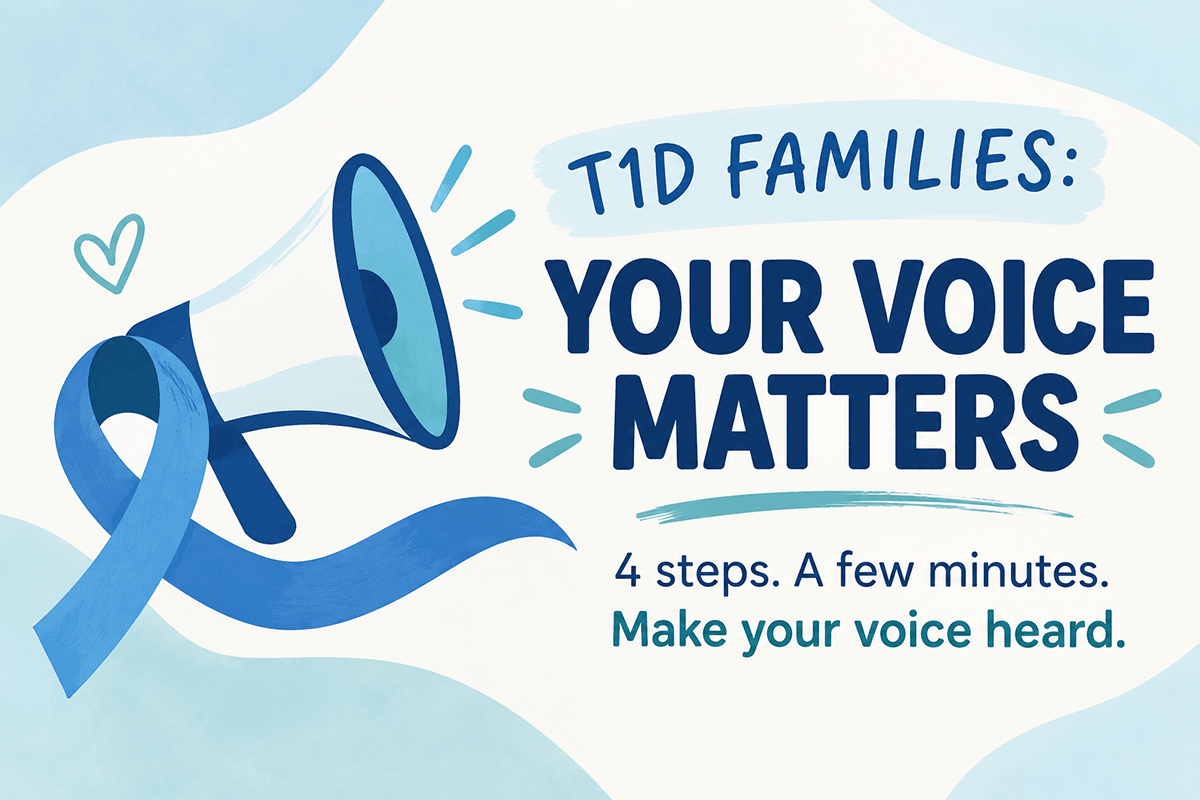
It’s easy: Go directly to the Regulations.gov comment page
- Find the Comment box.
- Tell them briefly why this matters to you.
- Select Individual Consumer if you’re commenting for yourself.
- Review and submit.
Need a starting point?
“I support classifying unmodified deceased-donor pancreatic islet cells as organs for transplantation. As someone whose family lives with Type One Diabetes, I understand the daily burden of this disease and the danger of severe hypoglycemia. I support improving access to promising treatments while maintaining strong patient-safety standards.”
Better yet, make it your own. Tell your T1D story. That’s what policymakers need to hear.
Comments are public, so only share personal details you’re comfortable making public. HHS encourages comments by November 8.
Small action. A few minutes. One more T1D voice at the table. ❤️–Megan
Want to See What I Submitted?
For anyone who would find it helpful, here is the comment I submitted. Please feel free to use it for inspiration, but your comment doesn’t need to be this long. A few heartfelt sentences about your own experience with T1D will be powerful.
I am commenting in support of classifying unmodified deceased-donor pancreatic islet cells as organs and creating a pathway for their transplantation under HRSA and the Organ Procurement and Transplantation Network, with rigorous standards in place to protect patient safety, quality, equity and accountability.
I come to this issue first and foremost as a mother. My daughter, Ellie, has lived with Type One Diabetes (T1D) since she was eight years old. From the day she was diagnosed, insulin has kept her alive. We are profoundly grateful for insulin, continuous glucose monitors, insulin pumps and the extraordinary advances that have made living with T1D safer and more manageable.
But manageable is not the same as safe, and insulin therapy is not the same as having a functioning pancreas.
For families living with T1D, hypoglycemia is not simply a low number on a glucose monitor. A severe low can lead to confusion, seizures, unconsciousness and, in the worst case, death. As a parent, you learn very quickly that the medicine keeping your child alive can also become dangerous when the balance is even slightly wrong. That knowledge never entirely leaves you.
We have watched diabetes technology improve dramatically during the years Ellie has lived with this disease. Yet even with excellent care and sophisticated technology, T1D remains a relentless, 24-hour-a-day responsibility. Every meal, illness, activity, overnight period and unexpected change can affect blood sugar. Patients and families make countless decisions simply to reproduce, imperfectly, a function the human body was designed to perform automatically.
That is why advances in islet transplantation matter so deeply to families like mine.
I recognize that islet transplantation is not appropriate for every person with T1D and that transplantation and immunosuppression carry serious risks of their own. Patient safety must remain paramount. Reclassification should not mean lowering safety standards. Appropriate safeguards for donor screening, processing, sterility, quality, transplantation, equitable allocation and long-term patient monitoring should remain rigorous.
But the regulatory framework should also facilitate appropriate patient access to promising, potentially life-changing treatments rather than create unnecessary barriers to them.
My daughter is now a young adult. I have watched her grow from an eight-year-old learning to live with T1D into a remarkable young woman who has refused to let the disease define what she can do. My greatest hope is that her generation—and the children diagnosed tomorrow—will have choices that were not available when she was diagnosed.
We should continue pursuing better insulin, better technology and every promising avenue of research. We should also ensure that regulatory policy keeps pace with medical progress.
For patients who experience severe hypoglycemia despite intensive diabetes management, access to functioning donor islet cells may offer something profoundly important: not merely better numbers, but greater safety and freedom from the constant threat of a life-threatening low.
I urge HHS to establish a responsible pathway for classifying unmodified deceased-donor islet cells as organs under HRSA/OPTN oversight while maintaining strong, transparent standards for patient safety, quality, equitable allocation and long-term outcomes.
For families living with T1D, this is not an abstract regulatory question. It is about whether promising science can safely reach the patients whose lives may depend upon it.
Your story doesn’t have to sound like mine. It just needs to be yours.